Decanter’s Top 50 US Wines of 2026: Wines 40-31

Follow us
Add us as a preferred source on Google
We’re on our second set of 10 wines a day, covering wines 40 to 31, as we count down to the Top 10 on Friday, 20 November. (You can find 50 to 41 here, along with an explanation of our criteria for creating this list.)
Each of the wines below was rated 95 points or higher in the past 12 months by our US-based reviewers, represents the diversity of the country’s wine scene and has a particularly compelling story behind it.
These are wines that set a precedent in their regions, introduced new approaches in established areas, represent an evolution at a winery or showcase great vineyards or great winemakers working at their peak.
They come from Oregon, Washington and California’s Napa, Sonoma and Mendocino counties. Some are names you likely know, some may be discoveries for you. We hope you enjoy exploring our list!
What’s new for 2026
We have a few new features this year. First, don’t miss our prize giveaway! To celebrate the release of the 2026 list, we’re giving away a pair of tickets to a 2027 Decanter Fine Wine Encounter Grand Tasting – an opportunity to sample the world’s best wines, meet the winemakers and get to know the Decanter World Wine Awards winners. All you have to do is provide your name and email address.
To enter click here.
Since there were so many outstanding and exceptional wines released this year, we’re giving Decanter Premium members access to a curated list of 200 more top wines, including top 2023 Napa Cabernets, Oregon Pinot Noirs, West Coast Chardonnays, values for the holidays and more. We’re offering a 20% discount if you subscribe in November with promo code TOPUS2026.
Wine No. 40
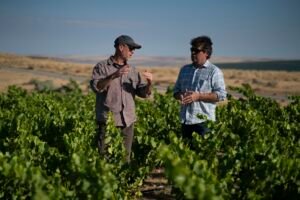
WeatherEye vineyard manager Ryan Johnson and Liminal winemaker Chris Peterson
(Image credit: Alexander Fortson / Liminal)
Liminal, WeatherEye Vineyard Block 47 Cabernet Sauvignon, Red Mountain, Columbia Valley, Washington, USA 2023
This wine expresses one of the more dramatic sites in the Columbia Valley: WeatherEye Vineyard, atop Red Mountain.
Running along the ridge, WeatherEye sits between 950 feet and more than 1,400 feet, above the ancient floodline from the waters that shaped much of the landscape. The soils are thin and rocky, the slopes exposed to harsh winds.
WeatherEye Vineyard partners, owner Cam Myhrvold and vineyard manager Ryan Johnson, have planted the property to micro-blocks, with the layout, density and vine-training customized to each change in exposure and soil composition.
Much of the site is planted with Syrah and other Rhône varieties that thrive in this challenging environment.
The Liminal label is a partnership, with Avennia owners Chris Peterson and Marty Taucher, focusing solely on WeatherEye fruit. (WeatherEye has its own label, and Johnson and his wife produce MTN/ART Wines from the site as well.)
Peterson, the winemaker, creates three ‘series’ of wines, including the Block Highlight Series, devoted to individual sections of the vineyard that stand out in a vintage.
With less than one acre of Cabernet Sauvignon, Block 47 sits lower down on WeatherEye’s steep slopes, facing southwest. During the day, it receives lots of sun, while at night, temperatures drop substantially, keeping acidity levels high.
The result, according to our reviewer, is a wine with both intensity and refinement.
Wine No. 39

Damien Lapuyade, left, has taken over as winemaker at Beaux Frères as Mike D Etzel expanded his management role.
(Image credit: Beaux Frères)
Beaux Frères, The Belles Sœurs Pinot Noir, Ribbon Ridge, Willamette Valley, Oregon, USA, 2024
This former pig farm in the Ribbon Ridge AVA has come a long way since founder Micheal G Etzel began planting it in 1988.
One of the big names in collectible Oregon Pinot Noir, Beaux Frères continues its long quality streak under its new shared ownership with Artémis Domaines, where the winery keeps company with the likes of Bordeaux first growth Château Latour, Burgundy’s Clos de Tart and Napa’s Eisele Vineyard.
Damien Lapuyade is now winemaker, while Mikey (Micheal D) Etzel – who grew up on the property – serves as Beaux Frères CEO and technical director, having succeeded his father.
They and veterans of the Beaux Frères team now have three vineyards to work with, as the Beaux Frères and Upper Terrace vineyards have been joined by a connecting site, the Bridge Vineyard, as of the 2023 harvest.
The Belles Soeurs Pinot Noir comes from selected parcels across the estate vineyards, now farmed following biodynamic practices.
Like the other Beaux Frères wines, it’s made using native yeasts, 30% to 50% new oak barrels, long and slow secondary fermentations and aging on the lees for up to a year before racking.
After a string of warm growing seasons reshaped the character expected of Willamette Valley wines, Mike D. believes the cooler, steady 2024 vintage is ‘a modern classic’.
Wine No. 38

Jason Gorski serves as DeLille’s vice president of winemaking.
(Image credit: DeLille)
DeLille Cellars, Chaleur Estate, Yakima Valley, Columbia Valley, Washington, USA 2023
DeLille has long showcased Washington’s strengths through blending varieties and vineyards, having introduced this Left Bank Bordeaux-style red in 1992, along with its Merlot-led companion, D2.
More than 30 years later, Chaleur Estate remains among the state’s benchmarks.
(Its sibling, Chaleur Blanc, a barrel-fermented blend of Sauvignon Blanc and Semillon, is one of Washington’s leading whites.)
DeLille emphasizes fruit from the small, warm, dry and windy Red Mountain AVA in its wines, though the Chaleur Estate vineyard sources and blend percentages change by the vintage.
The 2023 bottling contains 66% Cabernet Sauvignon, 23% Merlot and 9% Cabernet Franc, all sourced from three of the top sites in the state.
Ciel du Cheval, in Red Mountain, provided Cabernet from a 1982 planting. Boushey, in a cooler part of the broader Yakima Valley AVA, delivered Merlot from an older block as well. Champoux, in the Horse Heaven Hills, has long been a source for Quilceda Creek’s renowned Columbia Valley Cabernet.
Jason Gorski, who started working with founding winemaker Chris Upchurch in 2011 is now vice president of winemaking, working with winemaker Nick Bernstein and assistant winemaker Mari Rossi.
The Chaleur Estate is aged almost entirely in new French oak for 20 months, then matured 10 months in bottle.
The team has delivered a relative bargain in Bordeaux blends, at 96 points and $90 on release, compared to many of its West Coast counterparts.
If you haven’t been paying attention to Washington Cabernet in a while, here’s a reason to revisit it.
Wine No. 37

Mark Wentworth is now working with grapes from three estate vineyards in Mendocino.
(Image credit: Lucille Lawrence)
Wentworth, Nash Mill Vineyard Pinot Noir, Anderson Valley, Mendocino County, California, USA 2024
Growing up, Mark Wentworth loved being out in the forest. Now he’s growing Pinot Noir and Chardonnay amid the redwoods of western Mendocino County.
Starting in 2014, with an undeveloped plot of land, he has collected three prime properties, totaling 25 acres of vines, in the Mendocino Ridge and Anderson Valley AVAs. Along the way, he has been joined in his venture by his partner, Katie.
The past few vintages we’ve reviewed have been consistently outstanding to exceptional across the portfolio, with 2024 being the best overall.
This Pinot Noir comes from their Nash Mill Vineyard, planted in 2000 in one of the coolest parts of Anderson Valley, about 12 miles from the Pacific Ocean.
Wentworth acquired it in 2017; it has a permanent cover crop and hasn’t been tilled since, in keeping with his effort to build soil health. A committed conservationist, Wentworth has relied on organic and regenerative farming practices from the beginning.
The site sits near where two waterways converge, including Mill Creek, an important salmon and trout spawning run. Wentworth partnered with the Nature Conservancy and Trout Unlimited to help restore it. The winery also donates to 1% for the Planet.
Surrounded by the redwoods and other evergreens such Douglas firs, madrones and pine trees, tiny Nash Mill vineyard really seems to deliver its Mendocino terroir into the glass.
Wine No. 36

The Benton-Lane team has been more closely studying the soils in its vineyard blocks.
(Image credit: Benton Lane Vineyard)
Benton-Lane, Cima Single Block Series Pinot Noir, Lower Long Tom, Willamette Valley, Oregon, USA, 2024
Benton-Lane is one of the biggest names in the often-overlooked southern Willamette Valley, with founder Steve Girard having helped pioneer the region in the late 1980s and early 1990s.
Now the area has its own sub-AVA (Lower Long Tom was approved in late 2021), and under the ownership of Huneeus Vintners, Benton-Lane has a new-ish winemaker and new winery.
Amael Orrego has changed up the wine lineup, cutting Pinot Gris and rosé to focus on estate wines: one Chardonnay and three Pinot Noirs.
The team has devoted significant time to studying the soils in its 140 acres of vineyards, some of which date to 1991. And the new winemaking facility has provided them with the flexibility to ferment small lots individually.
The winery’s single-block series of wines is designed to illustrate the estate’s micro-terroirs. The Cima Pinot Noir comes from the highest slopes, at an elevation of 800 feet/244 metres, on deep volcanic soils over sandstone bedrock.
While the site provides dark-fruit intensity, the 2024 vintage saw plenty of early rainfall and moderate temperatures throughout the growing season, allowing the wine to display Oregon’s classic elegance and freshness.
Also a leader in Oregon’s sustainable winegrowing movement, Benton-Lane dry farms its vineyards, which have three sustainable farming certifications: LIVE Salmon Safe and Bee Friendly Farming.
Wine No. 35

Avennia production winemaker John Sigmar works with head winemaker Chris Peterson to craft the wines.
(Image credit: Aubrie LeGault)
Avennia, Valery, Columbia Valley, Washington, USA 2023
From the partners in Liminal, Avennia – the original project from winemaker Chris Peterson and investor Marty Taucher – works with a different set of top-tier vineyards for its Bordeaux- and Rhône-style blends.
These sites include Red Willow and Boushey in the Yakima Valley, Sagemoor in the White Bluffs AVA and their own estate in Red Mountain, with Cabernet plantings going back to the mid-1980s.
Earlier this year, Avennia also bought Greg Harrington’s Walla Walla–based Gramercy Cellars.
Valery (the patron saint of wine in St-Emilion) is Avennia’s Merlot-based blend, with the grapes coming from an old-vine block in renowned Washington grower Dick Boushey’s vineyard, along with 10% Cabernet Franc from Champoux.
Peterson is clearly on his game, delivering excellence across sites and varieties, while reminding drinkers why Merlot used to be Washington’s most-popular red.
Wine No. 34

Chardonnay planted in White Salmon Vineyard benefits from the cooling effect of the Columbia River.
(Image credit: Peter Brehm of Brehm Vineyards)
Devona, White Salmon Vineyard Chardonnay, Columbia Gorge, Washington, USA, 2024
At $40, this Chardonnay is an incredible value from one of Washington’s legends.
Winemaker John Abbott helped found Canoe Ridge Vineyard, an early entrant in the Walla Walla Valley wine scene and a leader in Merlot. A decade later, he helped create Abeja, known for Columbia Valley Chardonnay, Cabernet and Merlot.
The 2024 vintage may be one of Abbott’s last few at Devona, the 1,000-case winery he and his wife founded to concentrate on small lots of Chardonnay and Pinot Noir.
Kelsey Albro Itämeri, owner and winemaker of itä wines, is taking over the brand from the couple in a gradual transition.
The Columbia Gorge AVA (not within the large, well-known Columbia Valley) crosses the border between Washington and Oregon, running along about 40 miles of the Columbia River, just east of the Cascade Mountains. While eastern Washington is warm and desert-like, the large river cools temperatures in this area.
White Salmon Vineyard, one of Abbott’s favorite sources for cool-climate Chardonnay, sits at 550 feet (168 metres) above sea level, and the mix of Chardonnay clones are own-rooted rather than grafted onto rootstock.
Abbott relies on traditional Burgundian techniques: fermentation in French oak barrels (no more than 25% new), partial malolactic conversion to soften the mouthfeel and lees stirring to enhance the texture.
The finished wine melds creaminess, fresh fruit and bright acidity. Our reviewer called it ‘a true beauty’.
Wine No. 33

The pristine barrel cellar at Vérité is just one example of the care taken with these wines.
(Image credit: Jackson Family Wines)
Vérité, La Joie, Sonoma County, California, USA 2023
The 2023 vintage made it tough to choose among the trio of red Bordeaux blends in Vérité’s lineup, as all three were stellar. But who doesn’t want more joy in their life?
Sonoma County often doesn’t get enough credit for the quality of its Cabernet Sauvignon; when blended by a master, from an artist’s palette of vineyards, it can rival the best in the world.
After meeting vintner Jess Jackson, Bordeaux winemaker Pierre Seillan moved to California and has helmed this Jackson Family Wines–backed luxury wine project since 1998. But his daughter, Hélène, has been training alongside him to take over.
Using the Jackson family’s vineyard resources to the fullest, the Seillans work with mature plantings across Sonoma County’s hillsides and benchlands.
Cabernet Sauvignon and Merlot come from both the Alexander Valley and Knights Valley AVAs, Merlot from Bennett Valley, and Merlot, Cabernet Franc and Petit Verdot from Chalk Hill.
They treat each variation in a site – soil, elevation, slope, exposure and so on – as what they call a ‘micro-cru’, giving them more than 50 parcels to harvest and ferment separately.
The winemaking and oak barrels for aging are then tailored to each lot, providing hundreds of options from which to structure the final blends.
The 2023 vintage – Vérité’s 25th anniversary – delivered everything the Seillans needed to create a masterpiece.
Wine No. 32

Chris Carpenter is known for his skill in working with Cabernet from mountain vineyards.
(Image credit: Jackson Family Wines)
Caladan, Cabernet Franc, Napa Valley, California, USA, 2023
Chris Carpenter’s track record speaks for itself. He is a winemaker in his prime, the man behind many of Jackson Family Wines’ high-end California Cabernet Sauvignons: Cardinale, Lokoya, Mt. Brave and La Jota.
At his newer project, Caladan (yes, that is the name of a planet in Dune), Carpenter gets to play more with Cabernet Franc and Merlot, creating a mountain-fruit take on his inspiration, Château Cheval-Blanc.
In his other winemaking roles, Carpenter has become to deeply knowledgable about vineyards across Diamond Mountain District, Howell Mountain, Mount Veeder and Spring Mountain.
For both his Cabernet Franc and his Proprietary Red blend of five Bordeaux varieties, Carpenter leans heavily on Yverdon Vineyard on Spring Mountain.
At an elevation of 2,000 feet, it’s the coolest site in the Jackson Family portfolio of Napa mountain vineyards.
While the blend varies by vintage, the Cabernet Franc – which includes 13% Merlot in 2023 – also typically includes fruit from Wallis Vineyard in the Diamond Mountain District, W.S. Keyes Vineyard on Howell Mountain and Mt. Brave Vineyard on Mount Veeder.
Caladan’s inaugural vintage was 2015; nearly 10 years in, Carpenter struck gold with the near-perfect 2023 growing season. The result is a wine of elegance and deep complexity that will improve over the next decade.
Do you need a $275, small-production Napa red? If you’ve ever met Carpenter or tried any of his other wines, you know you want it anyway.
Wine No. 31

As part of their regenerative farming practices, the Morlet family lets Suffolk and Hampshire sheep graze the vineyard rows to help improve soil health.
(Image credit: Morlet Family Vineyards)
Morlet Family Vineyards, Mon Chevalier Cabernet Sauvignon, Knights Valley, Sonoma County, California, USA 2023
Founded by Luc and Jodie Morlet in 2006, Morlet Family is truly a family affair: No partners, just what the couple has achieved on their own over the past 20 years, developing three vineyards and restoring an 1880s-era winery. Their daughter, Claire, joined the business in 2024.
While the Morlets’ Napa Cabernets also stood out in the 2023 vintage, their Mon Chevalier (‘my knight’) bottling provides further proof that Sonoma Cabernet can compete with the best.
The tiny vineyard, their first, is located in Knights Valley, also home to Peter Michael Winery, where Luc served as winemaker for five years after training with renowned consultant Michel Rolland.
Luc was born into a French winegrowing family, but relocated to California to be with Jodie. He brings French techniques and an inventive mind to his winemaking; his pursuit of harmony led him to create and patent a berry-sorting machine and a device for gently draining the oak puncheons in which he ferments the wines.
In addition to Bordeaux varieties, Morlet Family also produces excellent Chardonnay, Pinot Noir, Sauvignon Blanc, Semillon and Syrah from leased vineyards in five other Sonoma appellations. The 2024 releases are well worth checking out.
Farmed organically, with regenerative practices, Mon Chevalier sits at elevations of 490 to 575 feet, in an area that is cooler and windier than the Morlets’ two Napa vineyards, allowing its Bordeaux varieties to ripen more slowly.
‘Plush, soft, and generous, it has impressive length,’ reviewer Jonathan Cristaldi wrote of this wine. ‘What a showing in 2023.’
Related articles
About Author